Force OWA Light Users to Premium OWA After Exchange Server May 2026 CVE Mitigation

Force OWA Light Users to Premium OWA After Exchange Server May 2026 CVE Mitigation

Exchange, Exchange Server SE / 2019 / 2016, Migration & Upgrade, Security & Hardening
Microsoft recently published guidance for Exchange Server addressing the May 2026 vulnerability. One important note in the article is related to OWA Light. Microsoft states that OWA Light — accessed by using an OWA URL ending with /?layout=light — does not work properly after the mitigation is applied. Microsoft also notes that this feature was deprecated several years ago and is not intended for regular production use. For a deeper look at the OWA request path and frontend/backend authentication design, see Exchange OWA Authentication Deep Dive – Part 1. This can become a practical issue if some users previously selected the following option in Outlook on the web: "Use the light version of Outlook" When this option is selected, the user may continue to be redirected to the Light version…
Read More
What Happens to Shared Calendars After Exchange Hybrid Migration?

What Happens to Shared Calendars After Exchange Hybrid Migration?

Exchange, Exchange Online, Hybrid, Migration & Upgrade
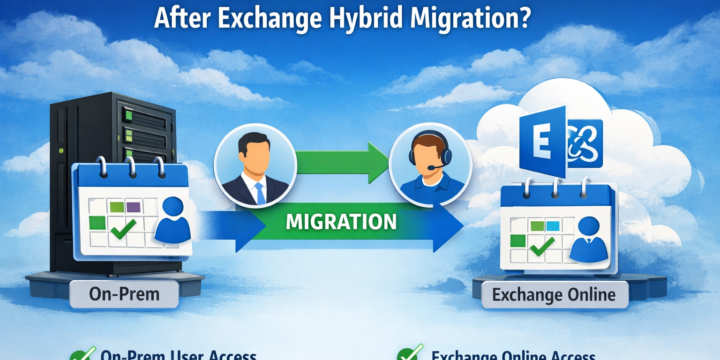
In Exchange Hybrid environments, shared calendar behavior after mailbox migration is often misunderstood. Many assume that calendar access breaks when a mailbox is moved to Exchange Online. In reality, the outcome depends on how permissions were configured before the migration. This article walks through a controlled scenario and shows exactly what happens. Scenario We use two users: buser01@onpremx.com bmuser01@onpremx.com Initial state: Both mailboxes are on on-prem Exchange Users can access each other’s calendars Step 1 – Test Default Behavior (On-Prem → On-Prem) Without assigning any permissions: Add calendar in Outlook Calendar is added successfully Only free/busy information is visible No subject or details This is expected. Default calendar permission: PowerShellAvailabilityOnlyAvailabilityOnly Step 2 – Check Existing Permissions Verify current permissions: PowerShellGet-MailboxFolderPermission bmuser01:\Calendar Get-MailboxFolderPermission buser01:\CalendarGet-MailboxFolderPermission bmuser01:\Calendar Get-MailboxFolderPermission buser01:\Calendar Typical result: No explicit…
Read More
Moved Mailboxes Are Shown in Disconnected Mailbox – Exchange 2010 SP1 SP2 SP3

Moved Mailboxes Are Shown in Disconnected Mailbox – Exchange 2010 SP1 SP2 SP3

Exchange, Migration & Upgrade
You have just moved some mailboxes from one Exchange 2010 SP1 ( or later ) mailbox database to another mailbox database but all the moved mailboxes are shown in disconnected mailboxes. This happens because of the "Soft Deleted mailboxes". Exchange doesn?t fully delete the mailbox from the source database immediately after completion of the move. Instead, the mailbox in the source mailbox database is switched to a soft-deleted state. The soft-deleted mailboxes are retained in the source database until either the deleted mailbox retention period expires or you use the Remove-StoreMailbox cmdlet to purge the mailbox.   You can see soft-deleted mailbox by running the following shell command Get-MailboxStatistics ?Database ?Mailbox Database Name? | Where-Object {$_.DisconnectReason ?eq ?Softdeleted?} You can delete all soft deleted mailboxes from a particular Mailbox Database by…
Read More

Installing Exchange Update Rollups on DAG (Database Availability Group) Members

Exchange, High Availability, Migration & Upgrade
Installing update rollups on DAG members is a straight forward task. We have to make sure that all the active databases have been moved to a different DAG member, activation of all databases on the server to be patched is blocked, mailbox database copy is suspended etc. Basically, the procedure is straightforward and should be followed per DAG member: 1.Appoint (next) DAG member; 2.Move away all active copies on that DAG member; 3.Prevent copies from activating on that DAG member; 4.Perform maintenance, e.g. down or upgrade DAG member; 5.Enable possible activation on that DAG member again; 6.Optionally redistribute database copies. Microsoft has two new scripts in the ?C:\Program Files\Microsoft\Exchange Server\v14\Scripts? folder of Exchange 2010 SP1. StartDAGServerMaintenance.ps1 and StopDAGServerMaintenance.ps1. In order to install a rollup on 2010 SP1 , follow the…
Read More